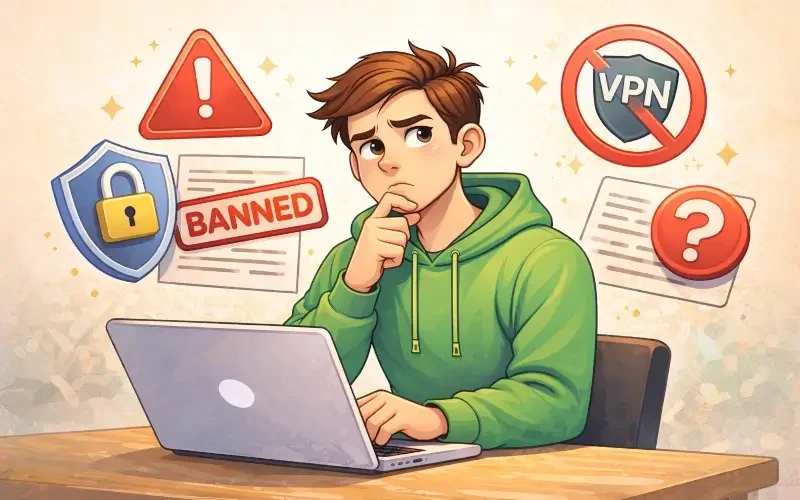
👀 Why You’re Reading This
If your GPT account got banned — or you’re worried it might — this probably feels unfair and confusing.
Money was involved. Tasks were completed. And suddenly, access is gone.
Here’s the reality:
GPT bans are not random. They follow strict, predictable rules enforced by advertisers — not the platforms themselves.
This article explains:
- why GPT accounts get banned,
- which mistakes are instant and irreversible,
- and how to avoid losing your account in the future.
If you’re already banned, this will also help you understand whether an appeal might work.
✅ TL;DR (Read This First)
- #1 reason GPT accounts get banned: VPN or proxy usage (often instant and final)
- Multiple accounts = ban (usually for all related accounts)
- Bans are appealable, but only ~30% succeed (mostly false positives)
- If you dislike strict, non-negotiable rules → GPT platforms are not for you
⚙️ Why GPT Accounts Get Banned
GPT platforms don’t ban users arbitrarily.
They ban users because advertisers demand it.
Every reward comes from an advertiser paying for a valid action.
If an advertiser suspects fraud — fake users, duplicate accounts, manipulated tracking — they don’t pay.
Platforms can’t override that.
They can’t negotiate intent.
They can only enforce rules.
This creates a zero-tolerance system:
- Legit behavior → paid
- Risky behavior → removed
That’s how the entire GPT industry works.
If you’re unfamiliar with this model, it helps to understand how GPT reward platforms work before judging enforcement.
🚫 The Most Common Ban Triggers (In Order)
1️⃣ VPN, Proxy, or Private Relay
The most common and fastest ban trigger.
Advertisers treat VPN traffic as fraud — even if you use it for privacy or forgot it was on. Detection is automatic.
Rule: VPNs must always be off.
2️⃣ Multiple Accounts (Person or Household)
One account per person. One account per household/IP.
Creating multiple accounts — even unintentionally — often leads to all related accounts being banned.
3️⃣ Offer Cheating or Manipulation
Including:
- completing “new users only” offers more than once
- faking screenshots or receipts
- automating actions
- triggering rewards without meeting requirements
These usually result in review-based bans, sometimes weeks later.
4️⃣ Emulator Usage
Using Android emulators for mobile offers is disallowed.
Advertisers detect emulator environments easily.
5️⃣ KYC or Country Mismatch
If your identity, IP, and claimed country don’t align, your account may be flagged or banned — especially during withdrawals.
6️⃣ Repeating Offers Against Rules
Some offers allow one completion per device. Others allow one per user, ever.
Ignoring those limits can trigger enforcement.
⏱️ Instant Bans vs Review-Based Bans
Instant bans happen automatically when systems detect:
- VPN usage
- multiple accounts
- emulator environments
No warning. No review.
Review-based bans happen after investigation, usually due to:
- advertiser complaints
- suspicious patterns
- failed verification
By the time you’re banned, the decision is already made.
📩 Appeals: When They Work (And When They Don’t)
Most GPT platforms allow appeals via email.
Reality check:
- ~30% of appeals succeed
- Successful appeals are usually system mistakes, not rule violations
- Knowing the rule but breaking it anyway almost never gets reversed
What might work:
- false VPN detection
- travel without prior notice
- household conflicts you can clarify
What won’t:
- “I didn’t know”
- “I only did it once”
- “Other sites allow it”
🛡️ How to Avoid Getting Banned (Non-Negotiable)
If you want to keep your account:
- Never use VPNs, proxies, or Private Relay
- Use one account per household
- Complete only offers you’re eligible for
- Don’t use emulators or virtual machines
- Match your KYC to your real location
- Inform support before traveling
- Keep screenshots and receipts
There are no loopholes.
Platforms enforce these rules because advertisers require it.
❌ Who Should NOT Use GPT Platforms
GPT platforms are a bad fit if:
- you rely on VPNs for privacy
- you want multiple accounts
- you expect warnings before bans
- you dislike strict, inflexible systems
This isn’t a judgment — it’s a compatibility check.
🔍 Where Freeward Fits (If It Fits at All)
Freeward enforces the same rules as other legitimate GPT platforms.
What differs is transparency:
- clear account states
- appeal access
- explanations for enforcement
Freeward doesn’t promise immunity.
If you break the rules, you can still get banned.
If this model feels unacceptable, Freeward will frustrate you too.